
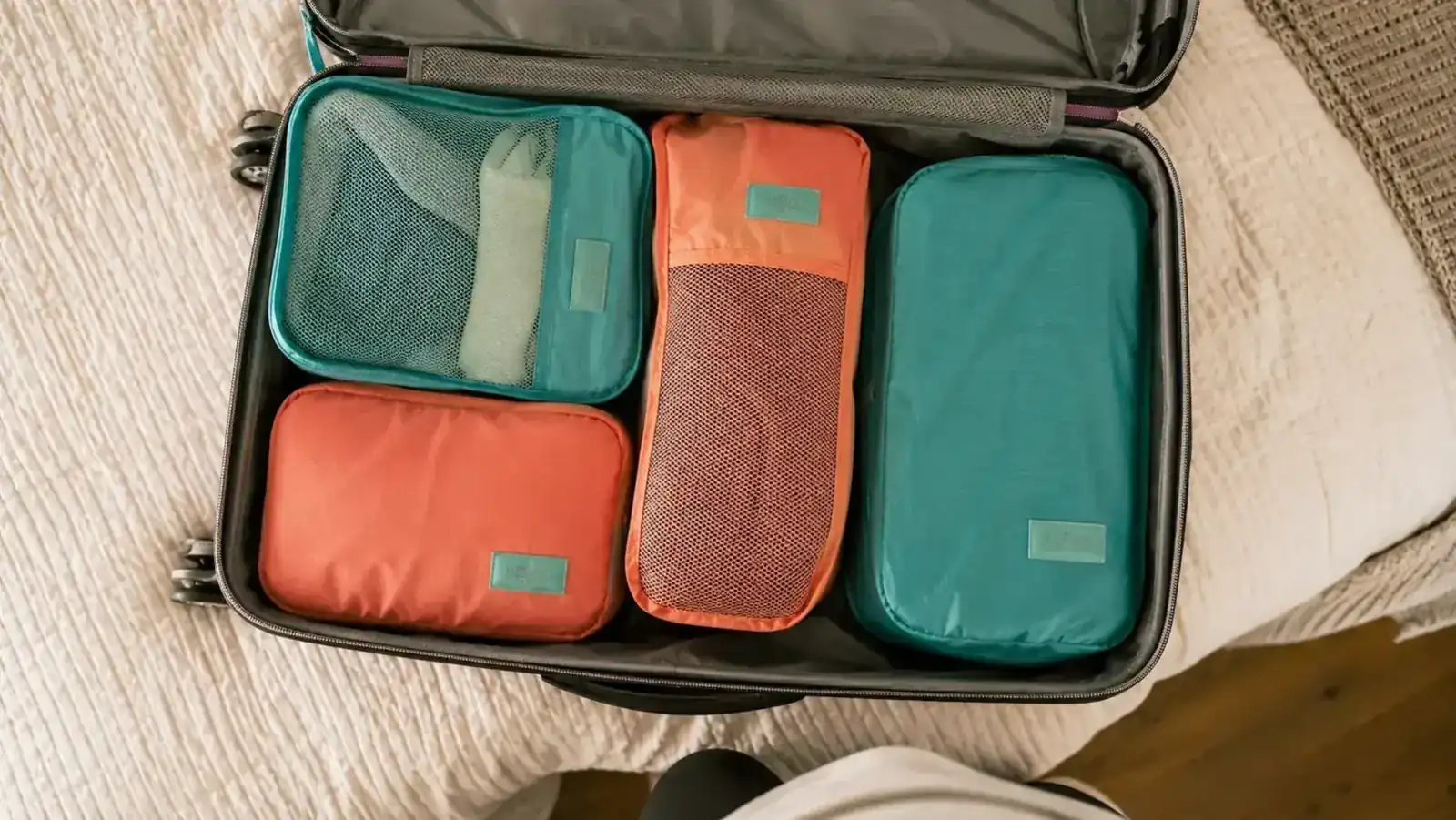
Three years ago I checked a bag on every single trip. I told myself I needed the space. Then I spent a long weekend in Lisbon watching the carousel for forty minutes while everyone else was already on the Metro, and I decided enough was enough. The real problem was not how much I owned, it was how I was packing. Once I switched to a compression cube system, two weeks of clothes fit reliably into a 22-inch carry-on, and I have not paid a checked bag fee since.
The tool that made it work is the Veken compression packing cube set. Not just any packing cubes, regular cubes without compression barely move the needle. The Veken set uses a double-zip design: one zip fills the cube, a second zip compresses it down flat. That second zip is the difference between a carry-on that fits in the overhead bin and one that you are embarrassingly gate-checking at the door. This guide walks you through the exact system I use, step by step.
Still checking a bag because you cannot fit everything? This is the system that fixes that.
The Veken compression cube set (9 pieces, four sizes) is the tool this whole method is built around. Rated 4.7 stars across more than 13,000 reviews, and under $22 for the full set.
Amazon Check Today's Price on Amazon →Step 1: Build a 14-Day Capsule Wardrobe Before You Touch Your Bag
The biggest packing mistake people make is starting with the bag. Start with the clothes, on your bed, before any of them go anywhere near a cube. Pull out everything you think you need for 14 days and lay it flat. Count it. You will almost always find you have packed for 21 days out of habit.
For two weeks, I work with this baseline: seven tops (a mix of tees and one or two nicer options), four bottoms (two pairs of pants, one shorts, one versatile skirt or dress depending on destination), seven pairs of underwear, seven pairs of socks, one light jacket or layer, one pair of walking shoes, and one pair of sandals or flats that nest in the bag corners. That is it. Everything needs to work with at least two other items. If a piece only pairs with one specific outfit, it stays home.
A capsule wardrobe is not about deprivation, it is about precision. Most travelers wear 20 percent of what they pack 80 percent of the time. This step forces you to make those choices at home instead of at the airport when you are already stressed.
Step 2: Sort Your Clothes Into Four Categories for the Four Cube Sizes
The Veken 9-piece set comes in four sizes: extra-large, large, medium, and small, plus a laundry bag and a shoe bag. The secret to this system is that each cube has one job. When everything has a designated cube, you stop hunting through your bag every morning and repacking resets fast after you unpack at a new hotel.
Here is how I sort: the extra-large cube gets all tops, rolled tightly. Rolling instead of folding is not optional here, it is what lets you see everything at a glance and fit the compression zip. The large cube gets bottoms, also rolled. The medium cube gets underwear and socks, loose but tidy. The small cube gets any accessories or extras, a swimsuit, a spare bag, whatever does not fit cleanly elsewhere. Shoes go in the Veken shoe bag and tuck along one side of the carry-on. The laundry bag lives flat at the bottom and fills up as the trip progresses.
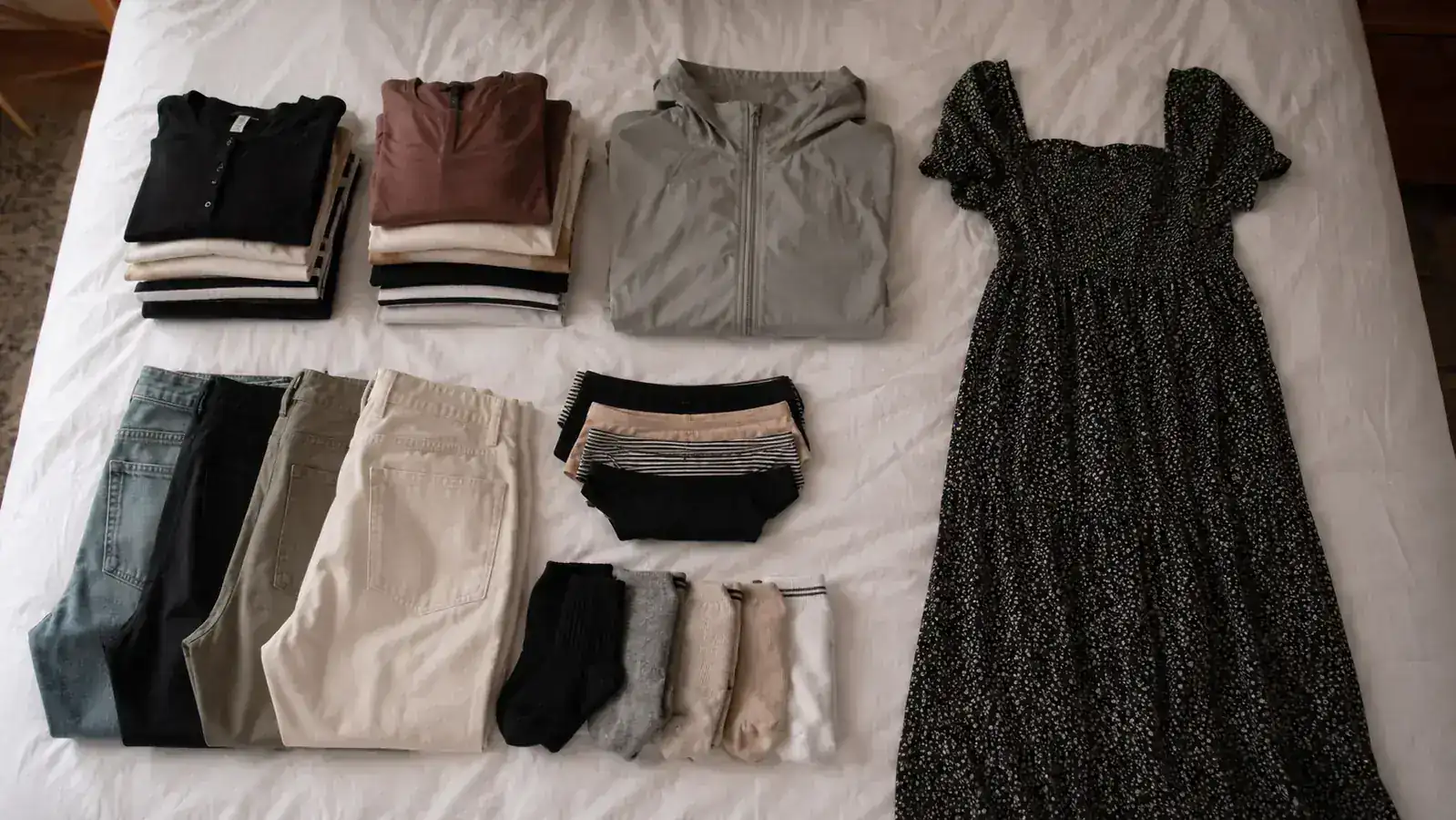
Having a dedicated laundry cube is a detail most people skip, and they regret it. On day nine of a two-week trip you do not want worn clothes mingling with clean ones. The Veken laundry bag keeps the divide clean and re-packing on travel days takes about three minutes.
Step 3: Roll, Load, and Compress Each Cube
Roll every garment before it goes into a cube. Start at the hem, roll toward the collar, keep it tight. Stack rolls vertically in the cube so you can see them all from the top, like files in a drawer. This is sometimes called the KonMari method applied to luggage, and it works because you can see and grab any item without disturbing the rest.
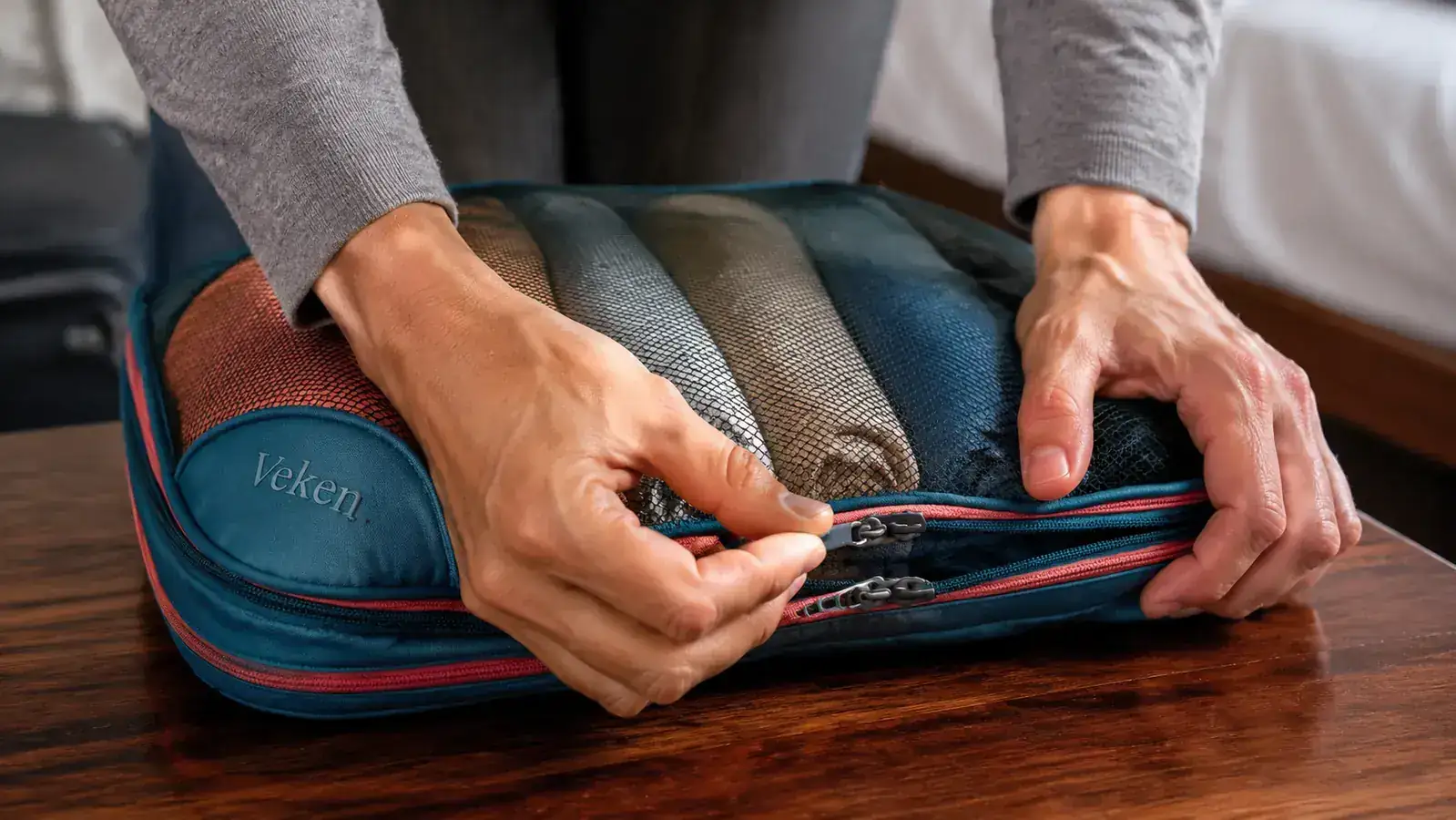
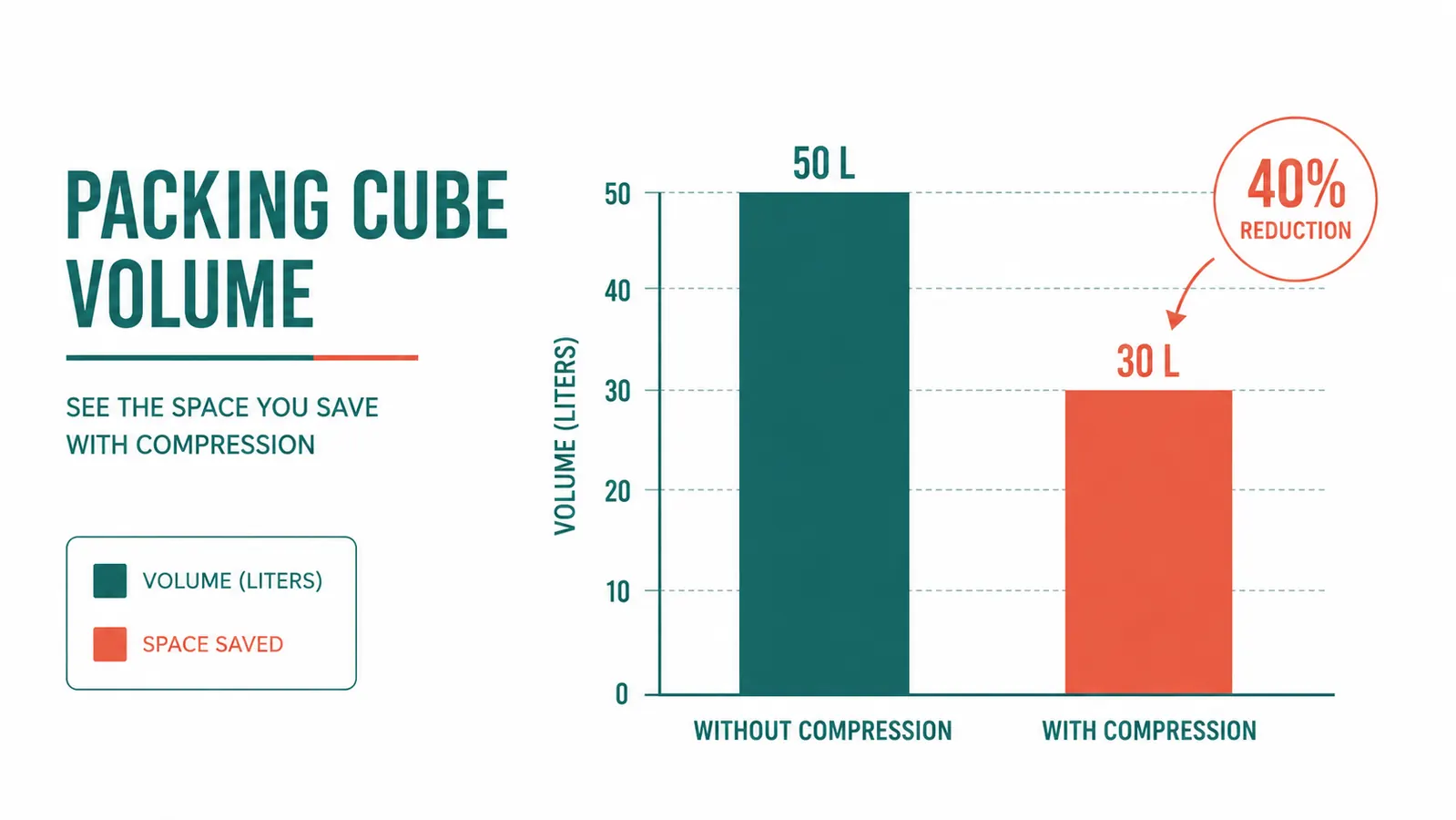
Once a cube is loaded to about 80 percent capacity through the main zip, close the main zipper completely. Then locate the second, smaller compression zipper that runs around the perimeter of the cube. Pull it closed in one firm, continuous motion. You will feel the cube flatten and tighten as the air works out. A fully compressed large Veken cube holding seven rolled tops drops from roughly 4.5 inches thick to about 2.5 inches. That difference, multiplied across three or four cubes, is where the magic happens.
Do not over-stuff before you compress. If the main zipper is straining, take one item out. The compression step only works if the main closure is fully sealed first. Forcing the compression zipper over a stuffed cube will eventually split the seam, and that is user error, not a product flaw.
A fully compressed large cube holding seven rolled tops drops from 4.5 inches thick to about 2.5 inches. Multiply that across three cubes and you have just reclaimed enough space for your shoes, your toiletry bag, and a jacket.
Step 4: Load the Carry-On in the Right Order
How you load the bag matters as much as what goes in it. The goal is a flat, brick-like layer at the bottom of the bag with zero dead air pockets. Dead air is wasted space, and wasted space is what makes bags feel full before they should.
My loading order: lay the extra-large cube flat at the bottom, then the large cube next to it or on top depending on your bag's dimensions. The medium cube fills in whatever gap remains on that layer. Shoes in the shoe bag go along one side edge. Then the small cube and any remaining items go on the top layer. The laundry bag unfolds flat over everything and acts as a divider from your personal item if you are digging through the bag mid-trip.
Your toiletry bag and any electronics should go in the carry-on's top compartment or your personal item, not inside a cube. You need those accessible at security without unpacking. If your carry-on has a back sleeve that slides over luggage handles, use it for your laptop or tablet rather than adding those to the main compartment.
A 22-inch carry-on with this system typically closes with room to spare. A 20-inch bag on a tight budget airline limit works too, you just need to be even more precise with your capsule wardrobe in Step 1. I have used both, and I would take a 22-inch for two weeks without hesitation.
Step 5: Test It the Night Before, Not the Morning Of
Pack your bag completely the night before your flight, and do a real overhead-bin simulation. Lift it over your head and push it into a shelf or closet rod. If you are straining, something needs to come out. A carry-on that technically zips but weighs nineteen pounds is going to get gate-checked on a regional connector even if it passes the size template.
Most budget and low-cost carriers cap carry-on weight at 15 to 18 pounds. Airlines like Southwest and Delta have no weight limit on carry-ons, but Spirit and Frontier can charge you for a heavy overhead bag. If you are flying anything other than a major domestic carrier, weigh the bag before you leave. A small luggage scale solves this in about ten seconds and costs under $10. I keep mine in the outside pocket of my carry-on so it is always with me for the return trip.
If you are over the weight limit after compressing everything, the culprit is almost always shoes. Shoes are heavy and wear space. Limit yourself to two pairs maximum: one on your feet, one in the bag. If a destination genuinely requires three pairs of shoes, you probably need a checked bag for that trip and that is completely fine. The system is not about suffering, it is about being honest with yourself about what the trip actually requires.

What Else Helps
The cubes do the heavy lifting, but a few other habits make the system hold up on longer trips. Packing a small ziplock with a two-week supply of any solid toiletries lets you skip the airline liquid rule stress entirely. A quick-dry travel towel (around 16 by 32 inches) compresses to the size of a softball and covers you at beach destinations or Airbnb rentals with stingy towel supplies. And if you are traveling to a hotel or destination with laundry access around day seven, plan on doing one wash cycle. That cuts your clothing count nearly in half and takes real pressure off the packing math.
For trips where I know I will be shopping or bringing back gifts, I pack one lightweight collapsible bag inside my carry-on. It takes up almost no space going out, and on the return it becomes a second personal item for overflow. Airlines allow one personal item in addition to your carry-on on nearly every domestic carrier, and most international ones. That second bag gives you breathing room without paying for an extra checked bag on the way home.
If you have never tried a compression cube system before, the Veken set is genuinely the right place to start. It is the set I started with and still use. The build quality on the zippers has held up across three years of weekly trips, the mesh tops let you see what is inside each cube at a glance, and having nine pieces in four sizes means you can dial in exactly which cube does which job for your specific packing style. Other sets I tried before these had zippers that started separating after about a year. The Veken ones have not.
Ready to leave the checked bag at home for good? The Veken set is how that actually happens.
Over 13,000 travelers rate it 4.7 stars. Four sizes, nine pieces, double-zip compression that genuinely flattens bulky clothes. It is the backbone of a two-week carry-on system that works trip after trip.
Amazon Check Today's Price on Amazon →